FOCUS ON SAFETY: Keeping track of your equipment's life cycle
Ensuring safety even for older systems
Systraplan systems are known for their robustness and exceptionally long service life. The fact that the systems continue to perform reliably even after many years is the best evidence of their quality for us.After 20 years of continuous use, many safety components have reached their load limit. As owner of the system, is it important to know that the calculated service life of these components ends after two decades.
Timely inspection or replacement protects you from liability risks and ensures continued safe operation. According to the EN ISO 13849-1 standard, a typical service life of 20 years is recommended for safety-related systems.
After this period, responsibility, including that of the original manufacturer, is transferred to the plant operator!
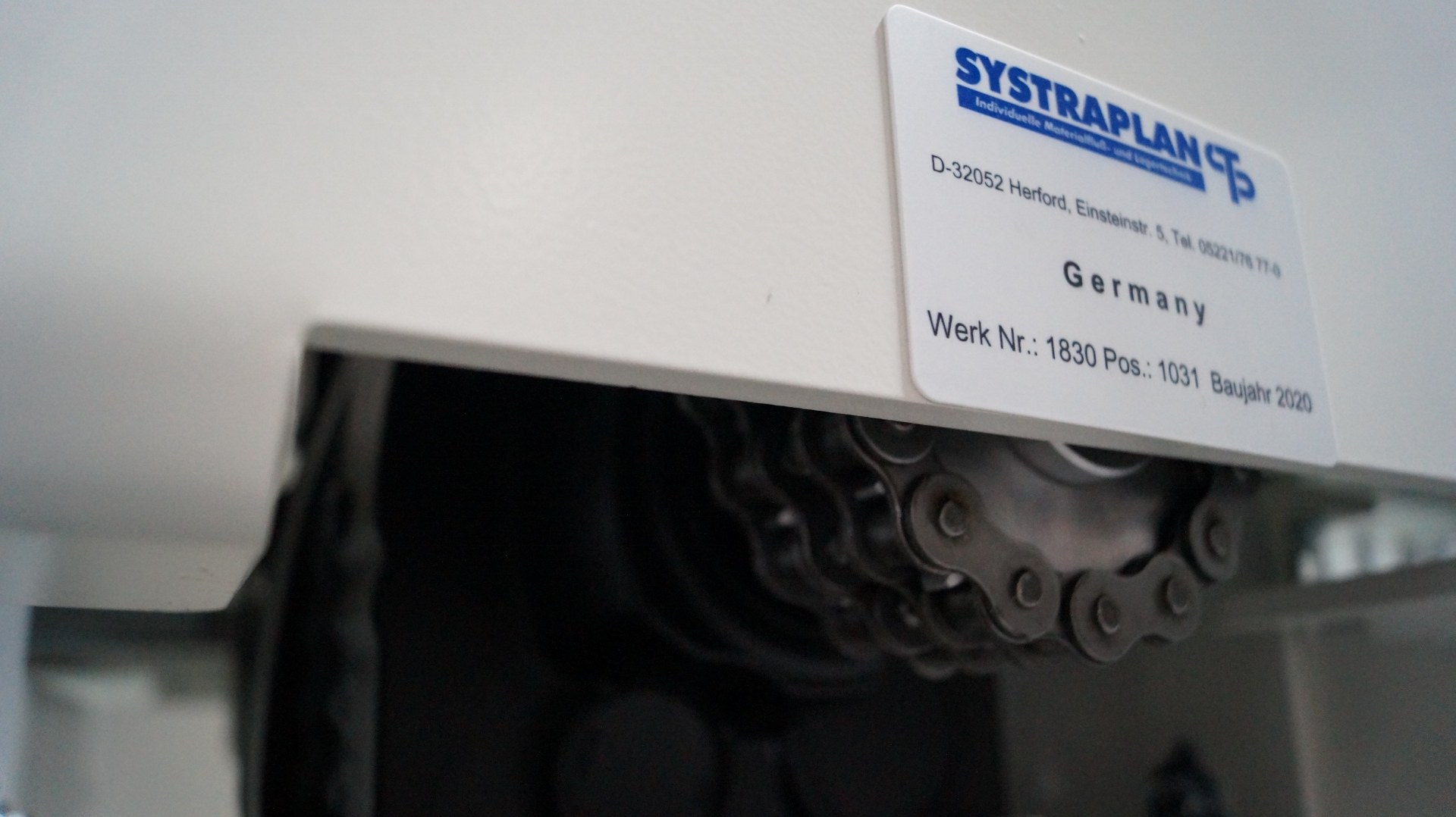
Example of a machine nameplate
Life cycle and failure rate of safety-related components
In the life cycle of safety-related components, we talk about a bimodal distribution – also known as a bathtub curve. An initial phase with a high failure rate is followed by a long, stable phase with a low probability of failure. After the operating life specified by the manufacturer, which in most cases is 20 years, the probability of failure increases again significantly. This is due to technical reasons, such as the aging of capacitors and contact surfaces.What does this mean for the owner?
Technology has changed dramatically over the past 20 years, and many components are no longer available in their old form, requiring modifications to the control system.A simple replacement of the safety components “old for new,” even if modifications are necessary, can be carried out, as in most cases an improvement in safety is not considered a significant change. However, each case must be considered individually.
There is no grandfather clause for unsafe systems!
According to §9 BetrSichV, the owner is obliged to regularly check the safety of the plants and, if necessary, take measures for modernization or retrofitting. Outdated safety technology can increase the risk of accidents and result in you no longer complying with legal requirements. It is therefore important to update the plants in good time to ensure safety, efficiency, and legal certainty.The liability trap
Once the operating life defined by the manufacturer has expired, the owner of the system can no longer rely on the safety functions of the components; responsibility is transferred entirely to the owner, with all the resulting consequences.This represents an enormous liability risk for the company and the person responsible. Fines may be imposed for violations of the Industrial Safety Regulation or other applicable regulations. In serious cases, criminal consequences are also possible, especially in cases of proven negligence or intent. In the event of damage, the employers' liability insurance associations and insurance companies check very carefully whether the system was “state of the art.”
Continuing as before is risky: What should be done now?
Replacing all components at once is expensive, but continuing as before is risky.If you have a specific system in mind, Systraplan can help you set the right course.
Systraplan evaluates the potential of a retrofit for your requirements and clearly outlines the advantages in terms of safety and cost-effectiveness. Benefit from our expertise in safety technology and make your existing systems fit for the future.
The following procedure is recommended:
- Status assessment: Identification of all safety-critical components and comparison with the manufacturer's specifications regarding operating life.
- Risk assessment: Verification of whether the existing protective measures meet current requirements for operational safety.
- Retrofit plan: Targeted replacement of outdated components with modern, diagnostic-capable systems. At the same time, the extent to which a general update of the control system is possible or advisable is examined.
Your benefits
Legal certainty
Adaptation to current machine directives and accident prevention regulations.Accident prevention
Installation safety is state of the art.Productivity
Minimize equipment failure risk and maintain productivity.
Spare parts warranty
Replacement of discontinued components (e.g., old PLC controllers) with available standard products.Sustainability
Extending operational life - Conserving resources by preserving the basic mechanical substance while modernizing the “brain” of the machine.
